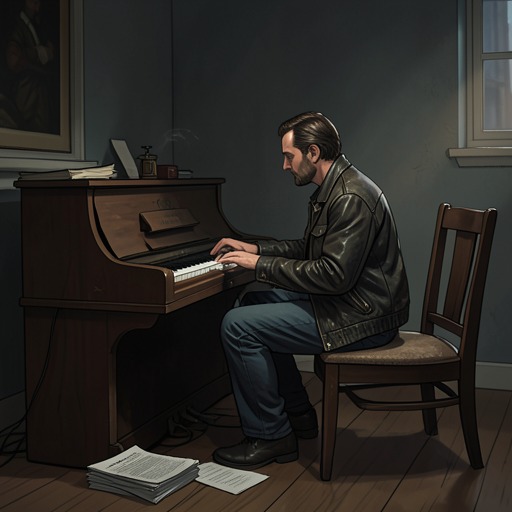
The artist is here
Cartes Postales from Greece“The artist is here” is a line from Laterna, Poverty and Honour that Panagiotis makes part of his public performance. Its significance lies in the contrast it draws: artistry is not defined solely by playing an instrument, but located in the person who plays. When Panagiotis delivers the concluding words and points to his heart, the refrain becomes a physical gesture as well as a statement, joining his musical work to the identity he has made for himself.
Wording and Meaning
The passage preserves the line in Greek transliteration: “O kalliteknis then einai ekeinos pou pezei violi i flaouto,O kalliteknis einai etho.” Panagiotis repeats its English wording to his audience: “The artist is not the man who plays violin or flute,The artist is here.” The source prints the two clauses without a space after the comma; together they move from a definition by instrumental skill to a declaration of presence. The line does not reject the violin or flute as instruments. Instead, it insists that playing them does not, by itself, make the player an artist.
The last words acquire their emphasis through Panagiotis’s action. As he says “The artist is here,” he points to his heart. The gesture locates the claim in himself without requiring a further explanation: artistry is presented as something embodied, rather than something established only by the instrument in a performer’s hands. The words are therefore at once a remembered piece of film dialogue and a compact statement of how Panagiotis wishes his performance to be understood.
A Refrain Brought to the Audience
The line has stayed with Panagiotis since he saw the film, and he often repeats it to listeners who already know the film. His audiences’ familiarity matters: he is not introducing an unknown slogan, but invoking a shared reference that connects his street performance to a popular screen story. Repetition turns the film’s words into part of his own act, a recognizable moment that listeners can anticipate and understand.
That connection is made personal by the way he performs the ending. The point to the heart gives the quoted words a visible counterpart, making the declaration more than a recital. Panagiotis presents himself as the figure to whom the line applies, while allowing the remembered film to remain audible in the performance. The resulting effect rests on both recognition and self-presentation: the audience knows the source, and it also sees Panagiotis claim the phrase for himself.
Film, Performance, and Public Identity
Panagiotis’s relationship to the film extends beyond this particular line. As a boy, he had watched it and dreamed of the itinerant life it showed. At seventeen, after his parents had saved enough to buy him a hand-cranked barrel piano, he set out on the road dressed in a tailored suit and wearing a flower in his buttonhole. The film’s words thus belong to a larger history in which its imagined performer helped shape his own ambitions.
The image on his hand-cranked barrel piano featured the film’s romantic stars, Jenny Karezi and Alekos Alexandrakis. But people who stopped to listen also learned that Panagiotis himself had appeared in the film, in a scene with small boys that viewers remembered. He became a celebrity and cultivated that association, dressing grandly and making sure people knew of his connection to the screen. Against this background, his frequent use of the refrain does more than express a general idea of art: it draws together his past as a film performer, his present as a musician, and the public persona he consciously maintained.
From the Road to Thessaloniki
After a decade of travelling, Panagiotis settled in Thessaloniki. He chose a city with a steady influx of tourists, students, and travelling salesmen, so that his potential audience continued to change and renew. Although gramophones were already being produced, many people still preferred dancing to a hand-cranked barrel piano. He rented a small house in the old town, stored the instrument on the ground floor, and played in squares and streets around the city.
In this setting, the refrain’s insistence that the artist is “here” gains a practical resonance: Panagiotis’s art takes place in public, before listeners who gather around his instrument. The line links that everyday work to the film that first gave him a model for it. Its remembered words, repeated before familiar listeners and completed with a gesture to the heart, become a concise expression of the identity he carried from the screen onto the road and into the streets of Thessaloniki.